Architecture
How it's built
Four pictures, drawn before the first line of code so the design could not be shaped to fit the result. Select a diagram to open it full size.
The system
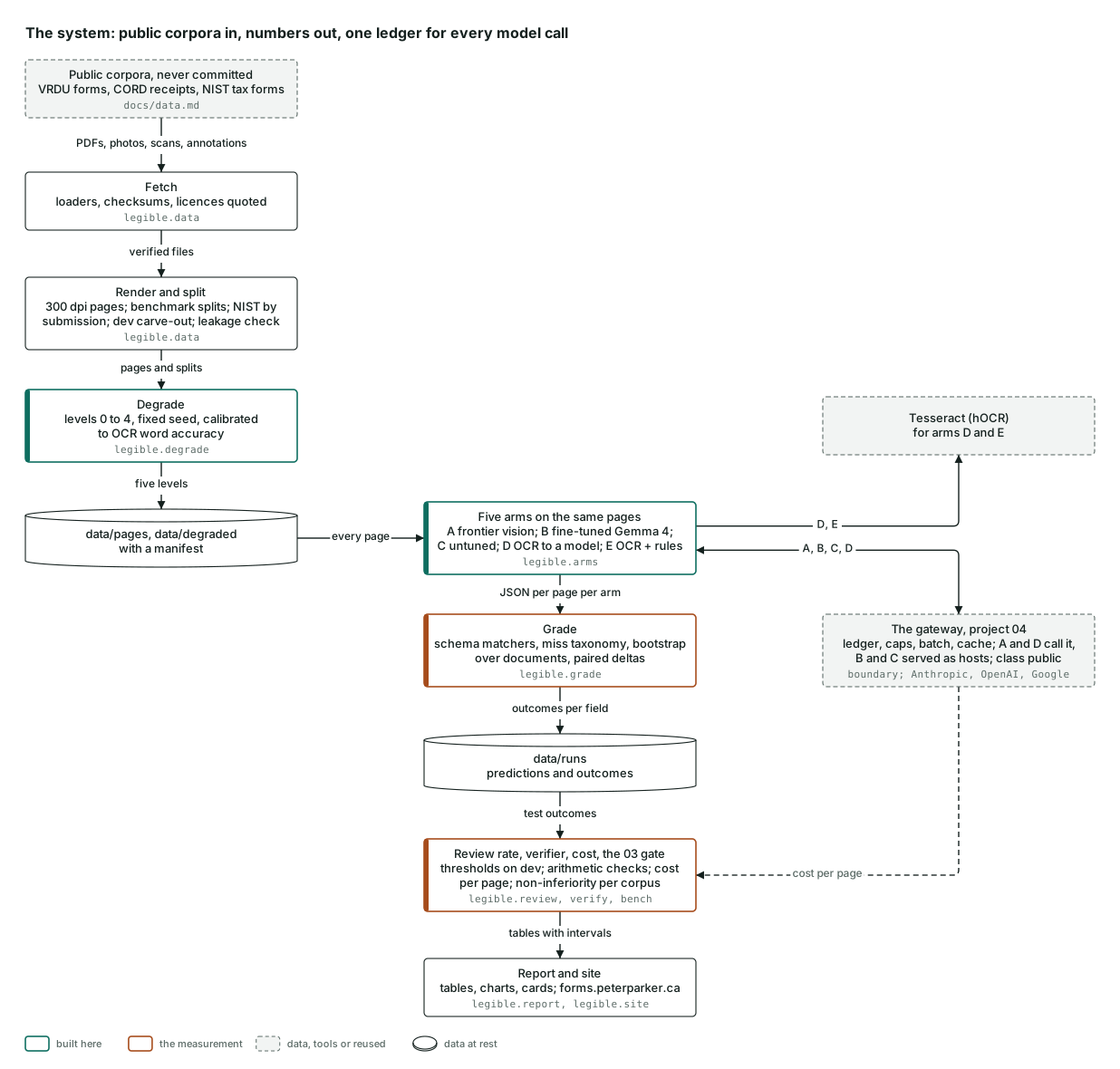
Three public sources come in and are never committed: Google's VRDU benchmark, with US Department of Justice registration forms and FCC political ad-buy orders; CORD's photographed receipts; and NIST's Special Database 2 of synthesised 1988 tax forms. Each loader checks the files against recorded checksums, and each licence is quoted before the first download.
Pages are rendered at 300 dpi and split so that a form design held out for testing never reaches training, with a check on every build that no document crosses. A degradation step then makes four worse copies of each test page from a fixed seed: noise, blur, skew and lost contrast, calibrated to what each does to OCR's word accuracy rather than to a filter's settings.
Every reader is sent the same page and the same instruction. Every model call, to a frontier vendor or to the fine-tunes on a rented card, goes through project 04's gateway, which writes a ledger row for each, so the cost per page has one source. One grader scores every field of every reader against the dataset's answer, and the release gate from project 03 decides whether the fine-tune is no worse than a frontier model, field by field.
One page, every reader
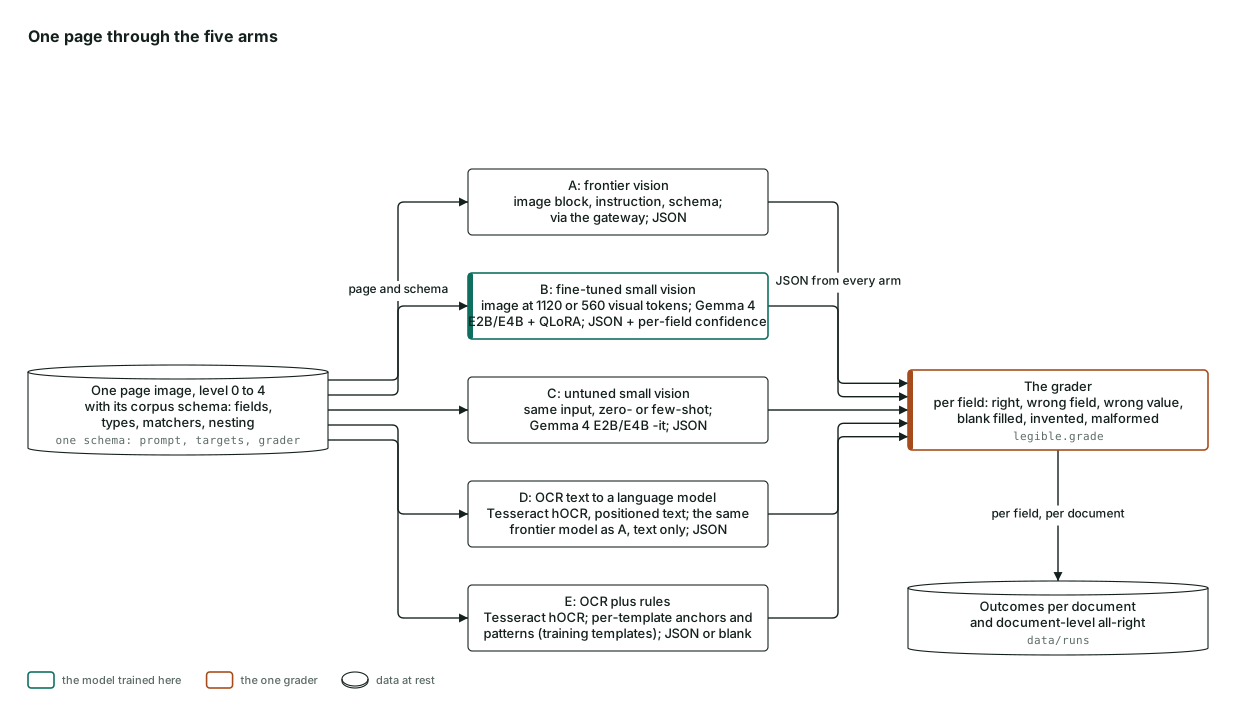
One schema per kind of form is the single definition the prompt, the training answers and the grader all read. The frontier models get the page image and the instruction. The fine-tuned Gemma models get the same, trained on it. The untuned bases get the same, so the gain from training is measured on equal terms. Two OCR pipelines read Tesseract's text instead: one sends it to Claude Sonnet, one applies rules learned from the training forms.
Azure Document Intelligence was added after these diagrams were drawn, as a sixth reader: a custom neural model trained on each training split, and its prebuilt receipt model for the receipts, sent the same pages through the same gateway.
The grader marks each field right, a wrong value, a value in the wrong field, a blank filled, or invented, and records whether the whole document was right.
Fine-tuning and serving
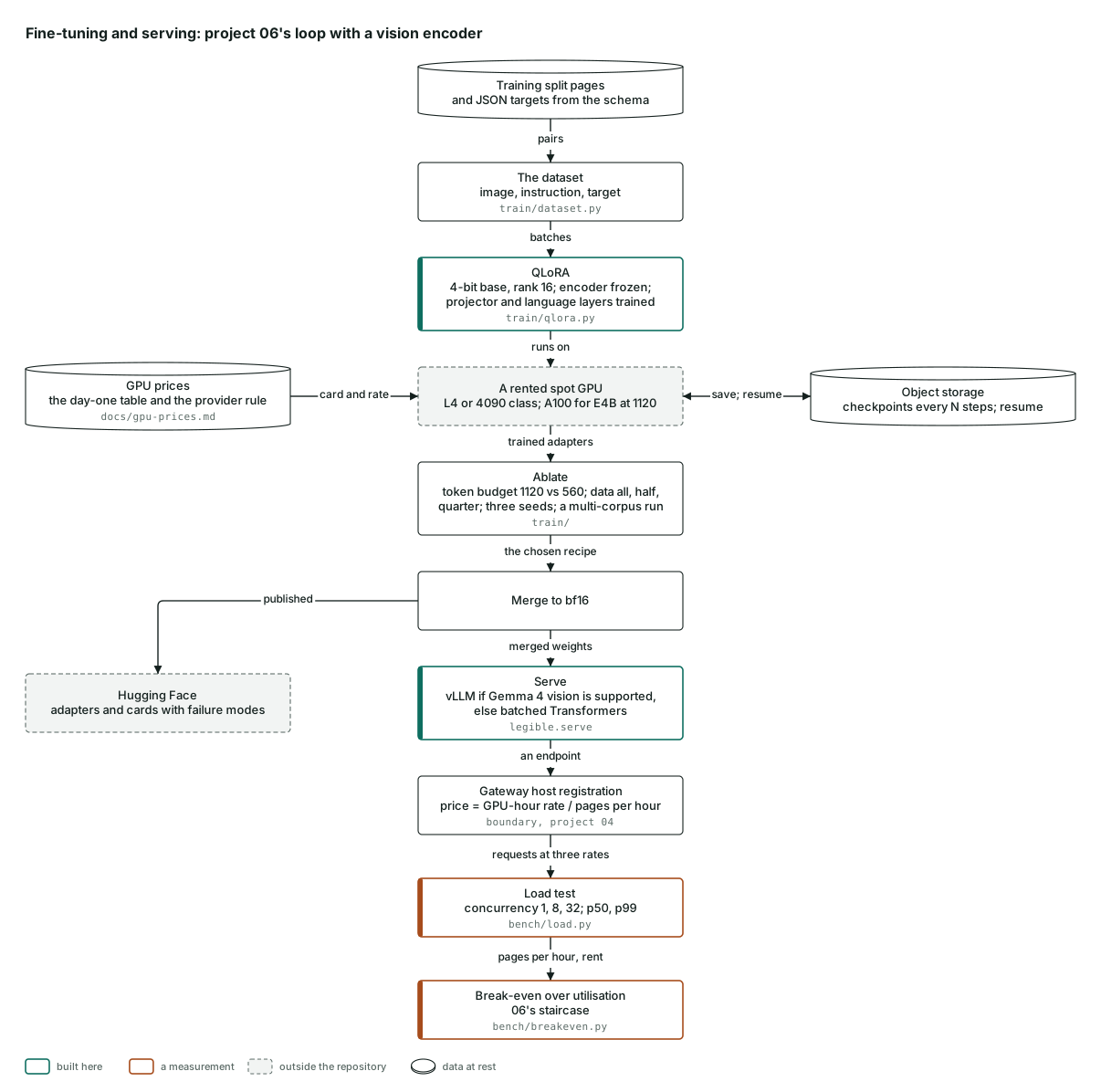
Project 06's fine-tuning recipe, with a vision encoder. Each training page and its answer become one example: page images and the instruction, then the answer as JSON, with the loss on the answer only. QLoRA keeps the base model frozen in 4 bits and trains small adapters beside its layers; the vision tower stays at full precision.
What changed from the plan: the 2B kept 06's rank-64 recipe and the 4B its rank-16 one; training ran on RunPod's Secure Cloud on 24 and 48 GB cards, because its cheaper Community Cloud had none free that day; and the outputs were read freely rather than forced into the schema's grammar, which pushed the models off their trained format.
Each adapter is served with vLLM on one RTX 3090, registered with the gateway, load-tested at 1, 8 and 32 requests in flight, and priced into the break-even with 06's arithmetic.
Which pages carry which claim
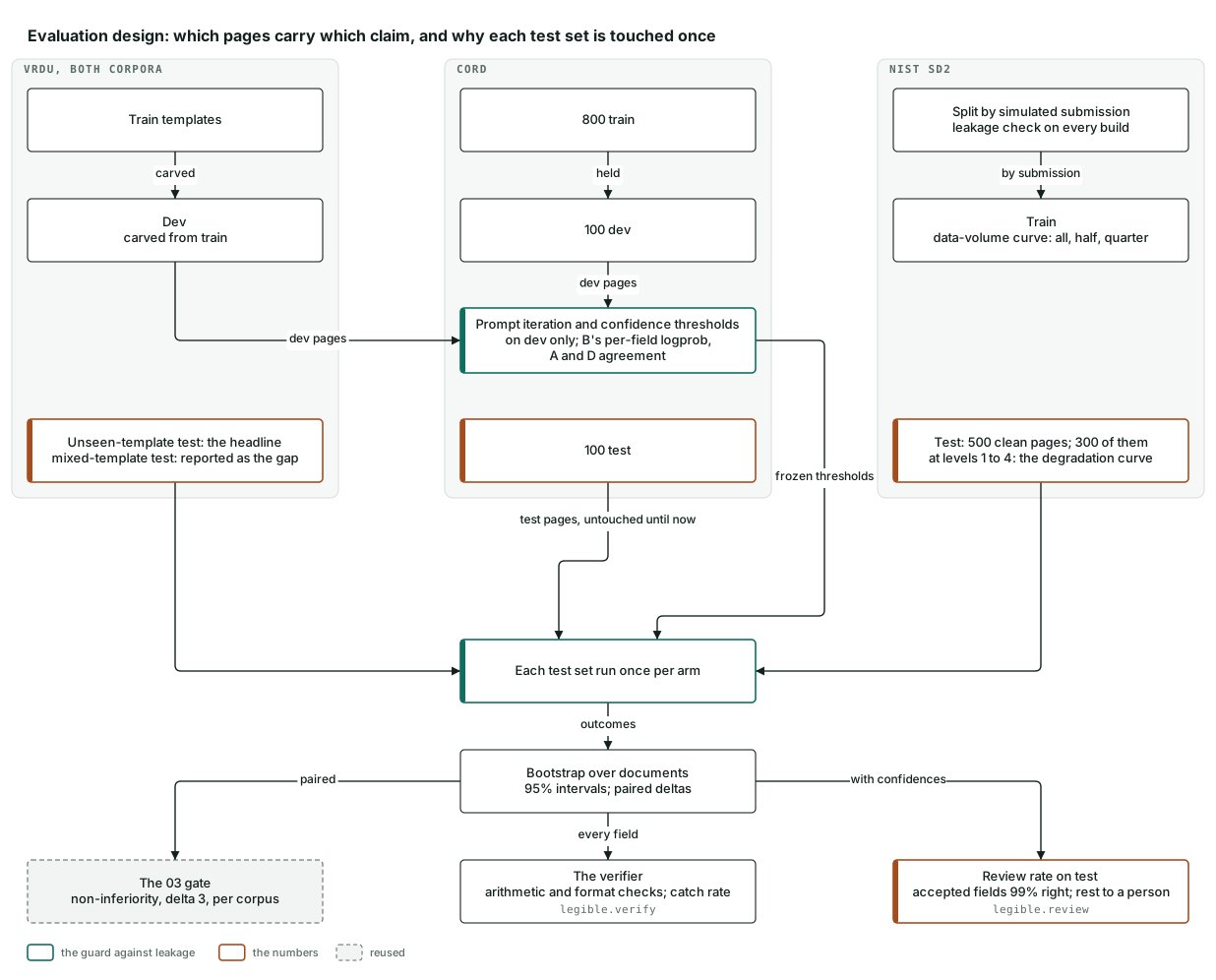
Prompts and confidence thresholds are tuned on development pages only. Each test set is then read once per reader. The headline for registration and ad-buy forms is the test set of form designs no training page came from; the test set of designs seen in training is reported beside it as the gap.
Every number carries a 95% interval from a bootstrap over documents, and comparisons between readers are paired on the same documents. The review rate is the share of fields that would still go to a person if the fields let through had to be 99% right, with the threshold set on the development pages.